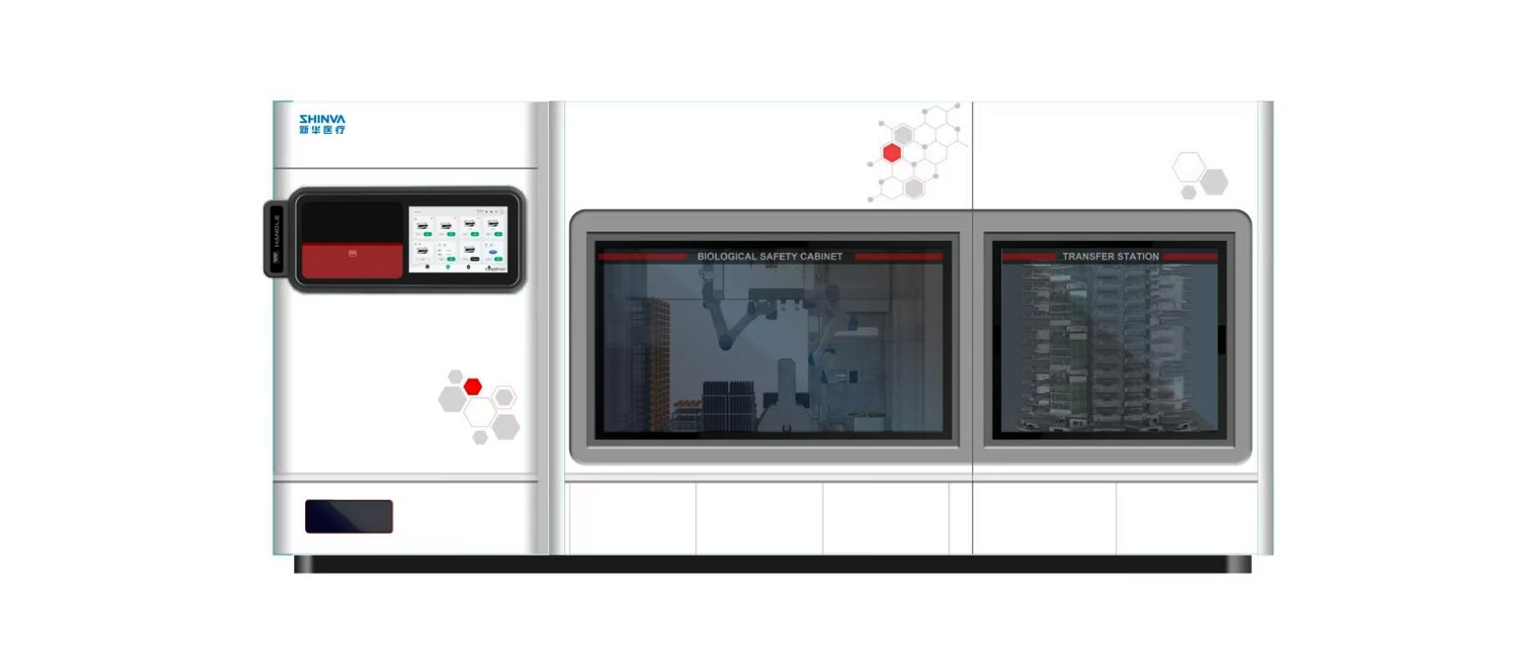
Fully-Automated Cell Workstation: Technological Breakthrough in Automated Cell Culture
Manual cell culture is plagued by well-known limitations including low efficiency and inadequate safety. Repetitive hands-on procedures consume massive amounts of researchers’ time and energy, while operational deviations and incomplete sterilization frequently occur. Consecutive workflow execution and full-data traceability are hard to achieve, making manual approaches ill-suited for high-throughput cell culture, virus inoculation and other demanding experimental scenarios. As life-science laboratories move toward intelligence and standardization, fully-automated, safe and reliable cell culture technologies have become an urgent industry requirement.
To address these pain points, Shinva has developed a Fully-Automated Cell Workstation with complete independent intellectual property rights, marking its strategic foray into laboratory automation. Integrating three core modules --fully-automated culturing system, biosafety chamber and intelligent consumable tower--the highly-integrated architecture enables end-to-end unattended cell-culture operations. It independently performs key workflows: cell thawing & cryopreservation, subculturing, cell-status interpretation, waste disposal, and full-chamber hydrogen-peroxide sterilization. Fine-tuned capabilities such as imaging analysis, automated cap-opening, precise liquid handling and oscillatory reagent dosing are also embedded, largely replacing manual lab work. Unlike competing solutions assembled from disjointed third‑party hardware lacking dedicated safety containment, this workstation delivers enhanced safety levels and broader application coverage. It supports high‑risk biological experiments and enables reliable 7×24 non‑stop operation.
Following multiple rounds of university-enterprise collaboration and iterative requirement optimization, the workstation has been deployed at the Wuhan Bio-Synthesis Center, perfectly matching high-standard experimental workflows. Full automation greatly boosts lab productivity by freeing scientists from repetitive manual tasks, allowing them to focus on core R&D work, and delivering remarkable practical outcomes and demonstrative value.
Furthermore, Shinva’s engineering team cooperates with the CAIR group in Hong Kong to advance intelligent upgrades. Leveraging AI agents, image recognition and digital-twin technologies, the system adaptively tunes culture parameters and optimizes operational workflows. It drives cell-culture workflows from basic automation toward true intelligence,delivering standardized technical support for synthetic biology and cell-therapy research.