III. System Process Flow
Tap water → Multi-media ( quartz sand + activated carbon ) filter → Softening filter →
Precision filter → High-pressure pump → Two-stage reverse osmosis system → Pure water
tank → Constant pressure water supply → Point of use
IV . System Equipment Description
4.1 Multi -media ( quartz sand + activated carbon ) filter
Quartz sand is generally used as the filter media in multi-media filters for pretreatment in
reverse osmosis and ultrafiltration equipment . Its main function is to filter out suspended
solids, colloidal particles, humic substances, and other impurities from water, reducingturbidity and improving clarity . It has advantages such as high filtration efficiency, low
resistance, large flow rate, fewer backwashing cycles, and long service life .
The system uses coconut shell activated carbon , which utilizes its high carbon content,
large molecular weight, and large specific surface area to physically adsorb impurities in the
water. When water flows through the pores of the activated carbon, various suspended
particles and organic matter are adsorbed into the pores. Simultaneously, chlorine adsorbed on
the surface of the activated carbon undergoes a chemical reaction, reducing it to chloride ions,
thus effectively removing chlorine. Activated carbon can adsorb residual chlorine in water ,
effectively extending the service life of reverse osmosis equipment and improving the quality
of the effluent, especially preventing ion exchange resins and reverse osmosis membranes
from being poisoned by free residual chlorine and from oxidative degradation . It also adsorbs
small-molecule organic pollutants in the water, showing significant adsorption and removal
effects on odors, colloids , pigments, and heavy metal ions, and also reduces COD ; further, it
can reduce the SDI value of the influent.
The core component of a reverse osmosis system is a spiral wound composite membrane
made of aromatic polyamide. This membrane has excellent desalination rate and water
production capacity. However, if the feed water contains high levels of dissolved organic
matter and oxidants such as free chlorine, it will cause severe damage to the reverse osmosis
membrane, such as degradation and oxidation, which is irreparable. Therefore, installing an
activated carbon filter before the feed water of the reverse osmosis system can effectively
remove dissolved organic matter and oxidants such as free chlorine from the feed water,
thereby protecting the reverse osmosis membrane components and extending the service life
of the pure water equipment .
4.2 Softening Filter
Softening, or reducing water hardness, prevents scaling. Softened water refers to water
whose hardness (mainly calcium and magnesium ions) has been removed or reduced to a
certain level . During the softening process, only the hardness decreases, while the total salt
content (conductivity ) remains unchanged. To prevent chemical scaling on the concentrate
side of the reverse osmosis membrane element, which would affect the membrane element's
output , sodium-type cation exchange resin is used before the reverse osmosis feed water toreplace Ca²⁺ and Mg²⁺ (the main components of scale formation) in the water
. When
the
exchange resin becomes saturated, it needs to be regenerated with NaCl to restore its
exchange capacity .
The softening filter consists of a fully automatic multi-way control valve, a resin tank
(containing a water distributor), cation exchange resin, a solvent tank, and a regenerant
(consumable). The multi-way control valve has multiple channels within the same valve body .
According to the set program, commands are sent to the multi-way valve, and the multi-way
valve automatically completes the opening and closing of multiple channels , thereby
realizing the fully automatic operation of backwashing, regeneration , and other processes .
4.3 Precision Filter ( Security Filter )
The precision filter is located between the pretreatment system and the reverse osmosis
system. Its main function is to remove residual particulate impurities such as quartz sand,
activated carbon, and resin powder from the water. These particulate impurities, when
pressurized by a high-pressure pump, may rupture the reverse osmosis membrane, causing the
conductivity of the produced water to exceed the standard. The filter element uses melt-blown
polypropylene, which has advantages such as deep filtration , large dirt holding capacity, long
service life, and easy replacement.
4.4 Two - stage reverse osmosis system
Reverse osmosis (RO) is a high-tech membrane separation technology made of polymer
materials and driven by pressure difference. It features high separation efficiency, no phase
change, simplicity, and high efficiency . Reverse osmosis technology is the most advanced
and energy-efficient membrane separation technology available today.
The reverse osmosis unit is the core component of a pure water machine . Whether its
design is mature and reasonable directly determines whether the reverse osmosis system can
meet the design requirements and is related to the performance of the entire system. Water
contains various inorganic salts that cannot be removed by ordinary filtration. However,
traditional ion exchange methods face problems such as high acid and alkali consumption,
short regeneration cycle, high labor intensity for workers, and serious environmental
pollution . Water treated by a reverse osmosis unit can remove most inorganic salts , organic
matter, microorganisms , etc.
Reverse osmosis membrane desalination mechanism : Reverse osmosis , also known as
reverse osmosis, applies pressure greater than the natural osmotic pressure to water containing
salt, causing osmosis to proceed in the opposite direction. This forces water molecules in the
salt water to the other side of the membrane, turning it into clean water, thus removing salt
from the water . The low-pressure side of the membrane receives the permeated solvent, i.e.,
permeate ( pure water ) ; the high-pressure side receives the concentrated solution, i.e.,
concentrate ( concentrated water ) .
Reverse osmosis membranes have a pore size of < 0.1 nm, which can effectively remove
dissolved salts, colloids, microorganisms, organic matter, etc. from water . They have the
advantages of good water quality, low energy consumption, no pollution, simple process, and
easy operation.
4.5 Stainless steel water storage tank
Since the water consumption at each water point is not fixed , the instantaneous water
intake may be too large, while the equipment produces a fixed amount of water per hour.
Therefore, a water storage tank is added to store the pure water produced by the system . The
water tank has a liquid level device, with high liquid level and low liquid level from top to
bottom. The high liquid level controls the operation of the high-pressure pump , and the low
liquid level controls the operation of the pure water pump.
4.6 Pure water supply system
A pure water supply system refers to supplying pure water produced by a pure water
purification system to water points through a constant pressure water supply device. This
device mainly consists of a pure water tank , a pure water booster pump , and a control unit.
This water supply method has the advantages of reliable operation, stable water supply
pressure, energy saving, and environmental protection.
V. Product Features
1. from municipal tap water , and the water quality meets the requirements of WS 506-2016
and WS 310-2016 management standards for cleaning pure water with a conductivity of
≤5μS/cm (25℃).
2. Process flow : Adopting the process of "pretreatment + double-stage reverse osmosis +
water tank storage + constant pressure water supply", this pure water equipment canefficiently remove odors, 99% of dissolved salts , bacteria and other microorganisms, and
various particulate impurities larger than 0.2um from the raw water ; prevent impurities
and dirt from clogging water supply pipes , cleaning and disinfection machines , and
various medical instruments and equipment , and ensure the water safety of all water
pipes and instruments and equipment .
3. The control system adopts a "PLC programmable controller + touch screen" automatic
control system. The entire system is automatically controlled by a microcomputer and
displays the equipment operating status, water quality, flow rate, pressure and other
real-time values online. The entire control system has automatic operation functions,
including automatic water production, automatic flushing, automatic shutdown when raw
water is insufficient or the water tank is full, and other functions.
4. This model can be equipped with network functionality to meet the needs of remote
monitoring and traceability, enabling interconnection of operating parameters between
the water purifier and the traceability system. It can also be equipped with mobile phone
connectivity, printing functionality, and an energy monitoring system.
5. To ensure the stability of equipment operation, the equipment does not use mechanical
pressure switches, but instead uses pressure transmitters to continuously monitor the raw
water inlet pressure, pure water outlet pressure, etc.
6. To save space , facilitate operation, and prevent dust from entering the equipment , the
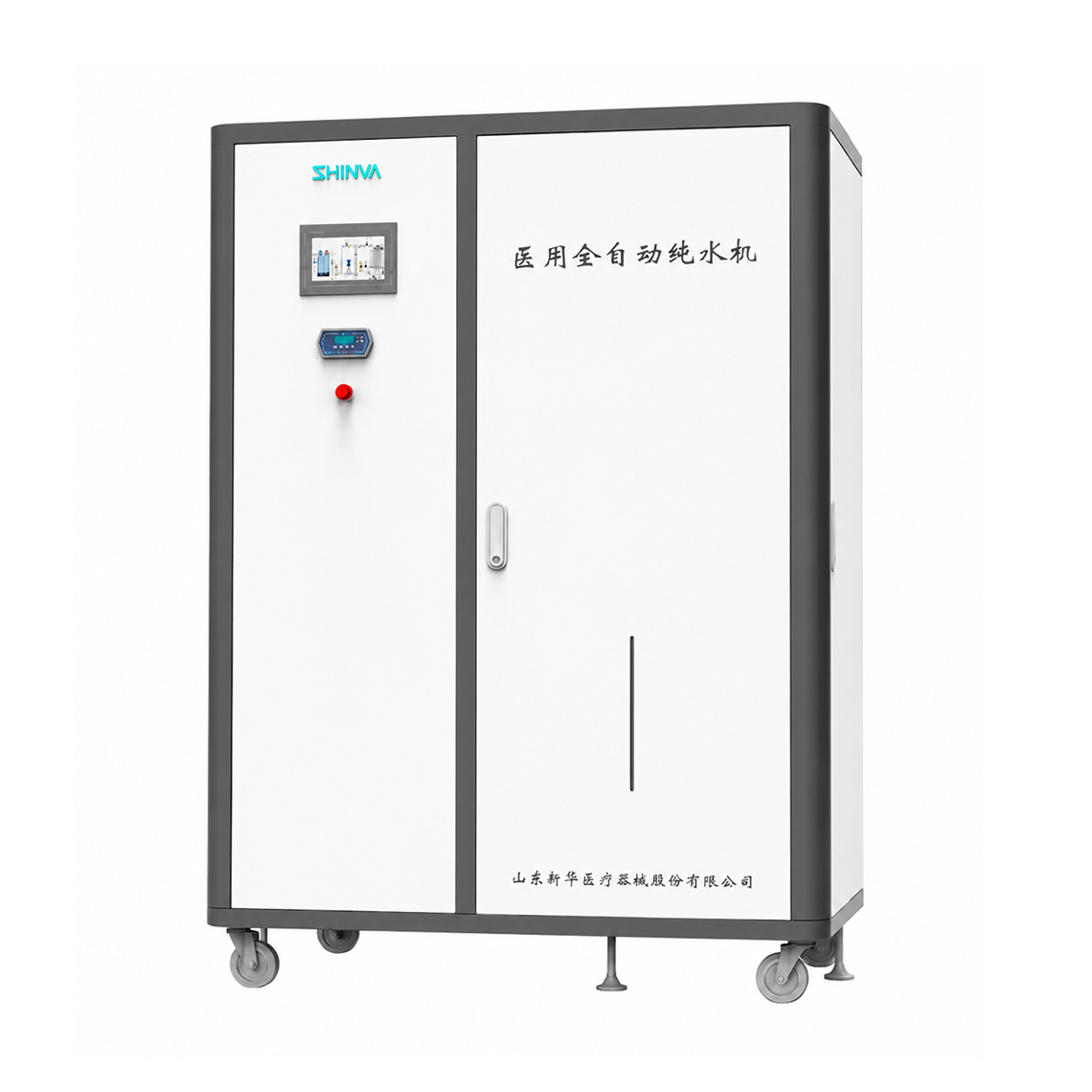
reverse osmosis unit is integrated into an aesthetically pleasing all-in-one cabinet with
access doors on all four sides , integrating the reverse osmosis and pure water supply
systems .
7. The main unit system uses UPVC pipes, and the main piping system is designed with no
dead corners, so that the water in all the pipes of the reverse osmosis unit can flow every
day, reducing the risk of microbial contamination .
8. The pretreatment system is equipped with a multi-media (quartz sand + activated carbon )
filter , a softening filter , a precision filter, and related auxiliary equipment . The
pretreatment system can automatically perform forward washing, backwashing , and
regeneration . To prevent the carbon canister from absorbing light and causing excessive
microorganisms, the pretreatment tank is blue.
9. has a flushing function, a conductivity meter for continuous monitoring and real-time
online display of the produced water quality , and a pure water flow meter to monitor and
adjust the output water volume in real time. It also improves water utilization through
reasonable process design.
10. The system uses a vertical multistage pump for high-pressure pumps and a horizontal
pump for pure water pumps. Flow-through components are made of 304 stainless steel,
and the reverse osmosis system uses spiral wound aromatic polyamide composite reverse
osmosis membrane elements .
11. The pure water tank is used to store reverse osmosis product water . The volume is
configured according to the user's site and needs. It is made of 304 stainless steel and is
equipped with a liquid level controller to automatically control the start and stop of the
equipment.
12. The pure water supply system adopts a constant pressure output method that is
technically safe, stable and energy-saving , and the water supply is not lower than the
minimum working flow and pressure requirements of the water-using equipment .
VI . Technical Parameters and Configuration List
6.1 Main Product Configuration
Multi-media filter
softening filter
Two-stage reverse osmosis system
High-pressure pump, pure water pump
Stainless steel pure water tank
Pure water flow meter , concentrated water flow meter
Solenoid valves , pressure gauges , pressure transmitters
Carbon steel powder-coated integrated cabinet
6.2 Technical Parameters
Raw water source: Municipal tap water , flow rate > 7 tons/h
Raw water pressure: 0.2–0.4 MPa (optimal is 0.3 MPa)
Inlet water temperature : 5~35℃ (25℃ is optimal)
Power supply : AC 38 0V / 50Hz / 9kW
Water production rate: 2000 L/ h
Pure water conductivity: ≤5μS/cm (25℃)
Pure water tank capacity : 2000L
Main unit weight : Approximately 400 kg
Control method: PLC + Touchscreen Fully Automatic Control
Main unit dimensions: 1650 × 800×1800 mm
VII. Requirements for On-site Equipment Installation Space, Piping, and
Electrical Circuits
Our company can provide installation layout diagrams for this equipment , as well as
relevant drawings regarding equipment room dimensions, water and electricity requirements,
etc., or we can provide layout and installation drawings based on the user's existing equipment
room. Please contact our company if needed.
7.1 Equipment reference dimensions and space and environmental requirements for the
installation site
1) The main unit of the water purifier is an integrated unit with dimensions of 1650
×800×1800 mm ( length, width , and height).
2) The pure water tank is a stainless steel cylinder with dimensions of 1300 mm in diameter
and 2150 mm in height .
3) pretreatment tank is cylindrical, with dimensions of 530 mm in diameter × 1750 mm in
height × 2 sets.
4) The solvent tank is barrel-shaped, with dimensions of 530 mm in diameter and 1050 mm
in height .
5) It is recommended that the water purifier be installed in a separate, well-ventilated room.
The floor and walls should be tiled or covered with other water-resistant materials and
waterproofed . The room height should not be less than 2.9 meters , and the load-bearing
capacity of the room should be fully considered. The room should be kept away from
direct sunlight , dry, and have good ventilation or dehumidification facilities . It is
recommended that the indoor temperature be maintained between 15 and 35 ℃, free from
dust and strong electromagnetic interference , and the doorway size should be greater
than 1400 mm ( the size of the largest component of the equipment ) .
Precautions: Avoid installing the water purifier in enclosed, poorly ventilated environments,
environments with heavy dust, oil mist, conductive particles, corrosive gases, flammable
gases, strong magnetic fields , high temperatures, high humidity , or environments prone to
rain .
7.2 Configuration and reservation of on-site piping
1) One water inlet pipe with a DN 40 interface and a pre-installed external thread (metal
wire end) control valve .
2) One pure water pipe with a DN 32 interface and a pre-installed control valve with
external thread (metal wire end) .
3) One drainage pipe with a DN 75 or larger connector, made of PVC or metal, ensuring
unobstructed drainage, and extending 50mm above ground level .
4) Based on the size of the water treatment room, at least one odor-proof floor drain should
be reserved. The floor drain should be located at the lowest point of the room and in a
position that is easy to clean , while also ensuring that the floor drain can drain smoothly .
Note : Before connecting the equipment to the pipeline, the inlet water and pure water
pipelines should be thoroughly cleaned to prevent impurities in the pipelines from affecting
the normal operation of the pure water machine and the water quality at the point of use.
7.3 Configuration and reservation of on-site electrical circuitry
A distribution box shall be installed at the equipment installation location . The
distribution box shall be waterproof and moisture-proof . The power distribution shall be
AC380V three-phase five-wire system with a power of ≥ 9 kW and good grounding
protection . The distribution box shall be equipped with a circuit breaker and neutral and
ground terminals, a Ф32 conduit shall be provided to lead to the bottom of the equipment, and
a waterproof power socket shall be pre-installed.
Note: If remote monitoring or connection to a traceability system is required, a network cable
interface should be reserved at the location of the pure water machine's electrical control box.