How to Choose Washer-Disinfectors
Choosing a washer disinfector is not simply a matter of comparing chamber volume, cycle time, or purchase price.
For a Central Sterile Supply Department (CSSD), the equipment has to work with the hospital's actual instrument mix, daily processing volume, facility infrastructure, staff workflow, and downstream sterilization process. A technically advanced machine can still become a poor investment when its loading system, utilities, documentation, or service model does not fit the facility.
That is why buyers asking how to choose a washer disinfector should begin with operational requirements rather than product brochures.
SHINVA provides multiple washer-disinfector configurations for different medical instrument cleaning and disinfection requirements. Buyers can review the when developing equipment specifications for a CSSD or hospital infection control project.
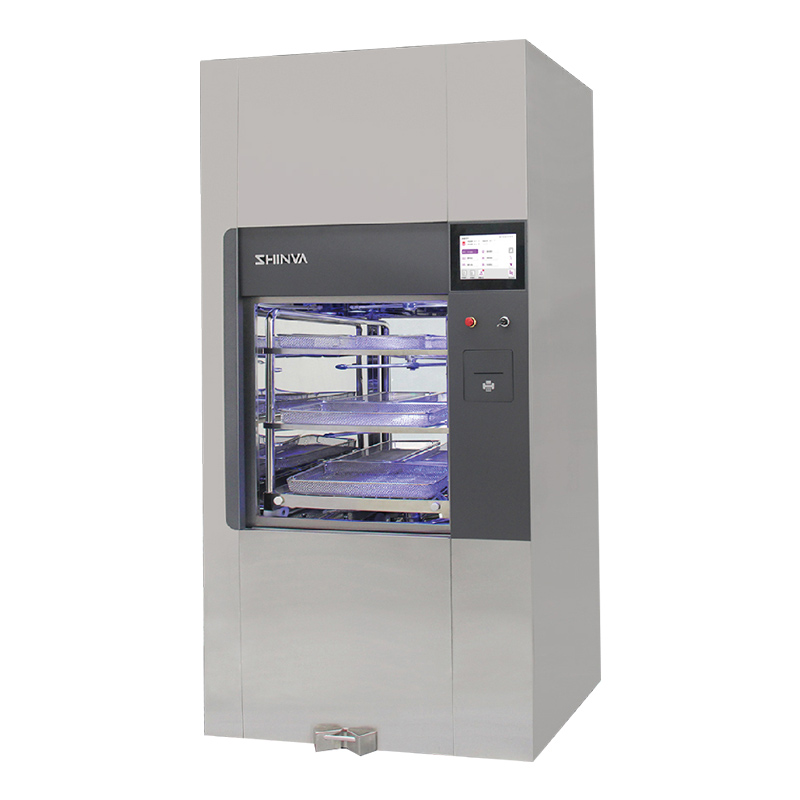
SHINVA Rapid-A-520 Washer-Disinfector for medical instrument cleaning and disinfection.
Define Your Washer-Disinfector Requirements
A productive supplier discussion starts with a clear definition of what needs to be processed.
Two hospitals purchasing a washer disinfector may need very different equipment even when they have similar bed counts. Surgical volume, instrument categories, workflow design, available utilities, and future expansion can change the required configuration.
Intended Use, Capacity, and Workflow Goals
Start by identifying the loads the equipment must process.
A general surgical instrument department may mainly process instrument trays and reusable utensils. Other facilities may also need to handle anesthesia accessories, ophthalmic instruments, minimally invasive instruments, bowls, containers, or other specialized loads.
This distinction matters because the loading rack can be just as important as the washer itself.
SHINVA's Rapid-A-520, for example, supports different wash-cart configurations for surgical instruments, anesthesia accessories, minimally invasive instruments, ophthalmic instruments, bowls, and other applications.
Instead of asking only, "What is the washer capacity?", buyers should ask:
How much of our actual workload can one configured cycle process?
| Requirement | What the Buyer Should Define |
|---|---|
| Load type | Instruments and reusable items to be processed |
| Daily volume | Typical processing demand |
| Peak volume | Highest expected workload |
| Turnaround target | How quickly loads must enter the next stage |
| Number of machines | Normal capacity plus redundancy needs |
| Future demand | Expected hospital or surgical growth |
Capacity should be based on workflow rather than simply selecting the largest available chamber.
An oversized system can increase investment and utility consumption. An undersized washer can create bottlenecks during peak surgical periods.
Compare Loading Systems, Not Just Chamber Size
One of the most important factors when choosing a washer disinfector is how instruments are actually loaded.
Nominal chamber volume alone does not tell buyers how productive a system will be.
Loading racks, baskets, spray interfaces, instrument arrangement, and usable processing space all influence practical capacity.
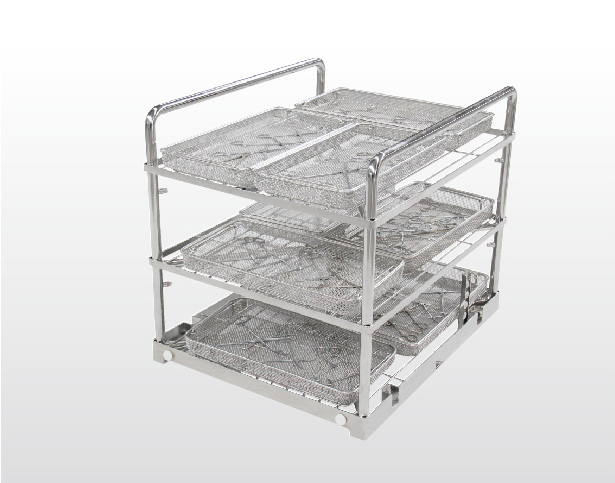
Example of a SHINVA instrument wash cart used to organize surgical instruments during automated washing and disinfection.
SHINVA's Rapid-A-520 uses modular wash-cart configurations designed for different instrument categories. Its product information also distinguishes between standard surgical instrument carts and specialized loading systems.
For buyers, this means the better comparison is:
| Specification | Better Buyer Question |
|---|---|
| Chamber volume | How many of our standard trays fit per cycle? |
| Rack levels | Which loads can each configuration process? |
| Loading accessories | Which racks are standard or optional? |
| Instrument compatibility | Can specialized instruments be processed correctly? |
| Throughput | How many required loads can be processed during peak hours? |
This turns a generic equipment comparison into a realistic CSSD workflow comparison.
Review Site and Utility Requirements
The washer disinfector must also fit the building.
Depending on equipment configuration, installation may involve electrical supply, water, drainage, steam, ventilation, and appropriate maintenance clearance.
These conditions should be reviewed before the purchase order is issued.
For renovation projects, existing infrastructure can significantly influence equipment selection.
For example, SHINVA describes the Rapid-A-520 as supporting integrated steam and electric heating configurations for different installation conditions.
Hospitals should therefore involve biomedical engineering and facility teams early in the selection process.
| Site Requirement | What to Confirm |
|---|---|
| Equipment space | Dimensions and service clearance |
| Water | Supply and required water conditions |
| Drainage | Connection and discharge requirements |
| Power | Electrical requirements |
| Steam | Availability where required |
| Ventilation | Room and equipment requirements |
| Access | Delivery and installation route |
Site information should be shared with the supplier before final configuration approval.
Compare the Specifications That Actually Matter
Medical equipment quotations often contain long specification sheets.
Not every parameter deserves equal weight.
The most important specifications are the ones that affect the hospital's actual processing requirements, installation, workflow, and lifecycle cost.
Cycle and Process Performance
Cycle time is often highlighted during equipment comparison.
However, buyers should understand what is actually included in the quoted cycle.
Depending on the machine and selected program, automated washing and disinfection may involve stages such as pre-washing, washing, rinsing, thermal disinfection, and drying.
The correct question is therefore not simply:
Which washer has the shortest cycle?
It is:
Which process can reliably support our required load and CSSD workflow?
A slightly longer process may still provide better operational value if it supports the required instrument mix, loading configuration, drying requirements, and department throughput.
Check Instrument and Material Compatibility
Equipment compatibility extends beyond whether an instrument physically fits inside the chamber.
Different reusable medical devices may have different processing requirements.
Before selecting a washer or program, hospitals should understand which materials and instrument categories will routinely enter the equipment.
Specialized items may require dedicated racks, connectors, protective systems, or processing methods.
The hospital should therefore compare:
Instrument Type → Loading System → Processing Program → Required Workflow
rather than assuming one standard configuration can handle every reusable device.
The reusable device manufacturer's processing instructions should also be considered when determining compatibility.
Evaluate Drying Requirements
Drying can influence how quickly processed instruments move into inspection and packaging.
A buyer should determine whether drying is integrated into the proposed configuration and whether its performance matches the facility's normal loads.
Important considerations include instrument type, load arrangement, cycle design, and required turnaround.
Drying should not be evaluated as an isolated feature.
It should be considered in relation to the entire sequence:
Loading → Washing → Disinfection → Drying → Inspection → Packaging
This is especially important in high-throughput CSSDs where delays at one stage can affect the entire processing workflow.
Consider CSSD Workflow Integration
A washer disinfector operates as one part of a larger sterile processing system.
A typical workflow may follow:
Receiving
↓
Sorting and Pre-Cleaning
↓
Automated Washing & Disinfection
↓
Inspection and Packaging
↓
Sterilization
↓
Sterile Storage
Equipment location, door configuration, loading and unloading methods, and transport systems can all influence how effectively this workflow operates.
For a new CSSD or a major department upgrade, buyers should consider the broader rather than evaluating the washer as an isolated machine.
Review Monitoring and Process Documentation
Hospitals increasingly require better visibility into sterile processing operations.
When comparing washer-disinfectors, buyers should define what process information needs to be monitored or recorded.
Depending on equipment configuration, relevant functions may include cycle information, operating status, alarms, water-quality monitoring, and process data.
For example, SHINVA states that the Rapid-A-520 includes an online conductivity monitoring system intended to monitor rinse-water quality and respond when additional rinsing is required.
Procurement teams should determine which monitoring functions are essential to their workflow rather than simply selecting the system with the longest feature list.
Review Quality Documentation Before Purchase
Documentation affects installation, commissioning, training, maintenance, quality management, and future service.
A buyer should know what documentation will be supplied before the equipment leaves the factory.
| Document Area | Why It Matters |
|---|---|
| Technical datasheet | Confirms final configuration |
| Installation requirements | Supports site preparation |
| Utility information | Confirms water, power, drainage, and steam needs |
| Operating manual | Supports training and daily use |
| Maintenance information | Supports lifecycle planning |
| Loading documentation | Confirms racks and accessories |
| Applicable quality documents | Supports procurement review |
| Commissioning records | Supports equipment handover |
The exact documentation package should reflect the selected product and destination market.
Buyers should avoid assuming that a document covering one model automatically applies to another.
Define Commissioning and Acceptance Requirements
Installation and commissioning responsibilities should be agreed before delivery.
The hospital and supplier should understand who is responsible for equipment positioning, utility connection, commissioning, training, and final acceptance.
Acceptance requirements should also be defined before purchase.
This makes it easier to determine whether the delivered system matches the agreed specification.
For international projects, clear responsibilities are especially important because the manufacturer, distributor, installation team, and end user may all be different organizations.
Compare Supplier Service Capability
Two washer-disinfector suppliers may offer similar machines but very different levels of long-term support.
Hospitals should therefore evaluate service during the selection stage.
Important questions include:
Who performs installation and commissioning?
Who trains operators and biomedical engineers?
How are technical problems reported?
How are spare parts supplied?
Is preventive maintenance support available?
Who provides local support in the destination market?
There is no single service model that works for every hospital.
The important point is that the service structure is clear before the contract is signed.
Evaluate Total Cost of Ownership
Purchase price is only one part of a washer disinfector's financial impact.
A better comparison considers the full lifecycle.
| Cost Area | Buyer Evaluation |
|---|---|
| Equipment | Main machine and configuration |
| Loading accessories | Racks, baskets, carts, and modules |
| Installation | Site preparation and commissioning |
| Chemicals | Detergents and routine processing materials |
| Utilities | Water, electricity, and steam |
| Maintenance | Preventive and corrective service |
| Spare parts | Availability, pricing, and lead time |
| Downtime | Operational impact of equipment unavailability |
| Expansion | Future throughput requirements |
This does not mean buyers should automatically select the most expensive machine.
It means they should understand what each quotation will cost to operate and support over time.
Separate Must-Have Features From Optional Features
One useful procurement strategy is to divide requirements into mandatory and optional features.
| Feature | Priority |
|---|---|
| Required instrument compatibility | Must Have |
| Required processing capacity | Must Have |
| Facility compatibility | Must Have |
| Suitable loading system | Must Have |
| Drying configuration | Project Dependent |
| Advanced data functions | Project Dependent |
| Automated loading | Optional / Project Dependent |
| Future automation integration | Project Dependent |
This prevents the tender from becoming a competition for the longest specification sheet.
A function only creates value when it solves a real operational requirement.
Common Mistakes When Choosing Washer-Disinfectors
Choosing Based Only on Chamber Size
A larger chamber does not automatically provide better practical capacity.
The actual loading configuration matters.
Comparing Only Cycle Time
Cycle times should be compared together with the processes included and loads being treated.
Ignoring Utilities Until Installation
Water, drainage, power, steam, and space should be reviewed before equipment approval.
Underestimating Loading Accessories
Racks and carts determine what instruments the washer can process efficiently.
Evaluating Service After the Purchase
Maintenance and spare-parts support should be considered before supplier selection.
Most poor purchasing decisions come from evaluating the washer as a standalone product instead of as part of a working CSSD system.
Buyer Insight: Choose Based on Fit, Not One Specification
There is no single specification that identifies the best washer disinfector.
The largest chamber does not guarantee the best throughput.
The shortest cycle does not guarantee the best workflow.
The lowest purchase price does not guarantee the lowest lifecycle cost.
And the longest feature list does not guarantee the most suitable solution.
Hospital buyers should instead determine whether the proposed configuration fits their:
instrument mix, processing capacity, CSSD layout, utilities, documentation requirements, maintenance resources, and future plans.
That creates a much stronger basis for comparing manufacturers and suppliers.
Conclusion: Choose Washer-Disinfectors Around the Real CSSD Workflow
Learning how to choose a washer disinfector means moving beyond simple product specifications.
Hospitals should first define their instruments, loads, capacity, workflow, and facility conditions.
They can then compare loading systems, process performance, compatibility, installation requirements, monitoring, documentation, supplier service, and total lifecycle cost.
The final decision should answer three questions:
Does the equipment fit our workflow?
Can the supplier support the project?
Can the hospital operate and maintain the system effectively over time?
When all three answers are clear, procurement becomes much less dependent on headline specifications or marketing claims.
Healthcare buyers can review the when developing equipment requirements and comparing available configurations.
For a CSSD project or detailed RFQ, with the intended loads, daily capacity, facility conditions, destination market, and required configuration.
Frequently Asked Questions
What is a washer disinfector used for?
A washer disinfector supports controlled cleaning and disinfection of compatible reusable medical instruments before subsequent sterile processing stages.
How do I choose a washer disinfector?
Start with the instruments and loads that need processing. Then evaluate practical capacity, loading systems, process performance, facility requirements, documentation, maintenance, and supplier support.
What washer disinfector specifications matter most?
The most useful specifications depend on the project. Practical load capacity, compatible racks, processing performance, installation requirements, drying, monitoring, and serviceability are generally more useful than a single headline specification.
Why are washer disinfector loading racks important?
Loading racks determine how different instruments are positioned and processed inside the equipment. The correct rack configuration can significantly affect practical capacity and workflow.
What affects washer disinfector lifecycle cost?
Lifecycle cost can include equipment, racks, installation, utilities, detergents, preventive maintenance, repairs, spare parts, training, downtime, and future expansion.