Washer-Disinfectors: Key Features and Validation Points
A washer disinfector is more than an automated washing machine for medical instruments.
The CDC emphasizes that thorough cleaning is required before high-level disinfection or sterilization because remaining organic and inorganic material can interfere with later processes. It also recognizes washer-disinfectors as a form of mechanical cleaning equipment and recommends using automatic units according to the manufacturer's instructions.
For technical buyers, the important question is not simply:
“Does this washer-disinfector have enough programs?”
A better question is:
“Can the system repeatedly deliver the required cleaning and disinfection performance for our actual loads, utilities, workflow, and validation requirements?”
ISO 15883-1:2024 establishes general performance requirements for washer-disinfectors used for reusable medical devices and also addresses validation, routine control, monitoring, and requalification. ISO 15883-2:2024 adds requirements for systems using thermal disinfection for critical and semi-critical reusable medical devices such as surgical instruments and anesthesia equipment.
Healthcare buyers can review the when comparing equipment configurations for CSSD and infection control projects.
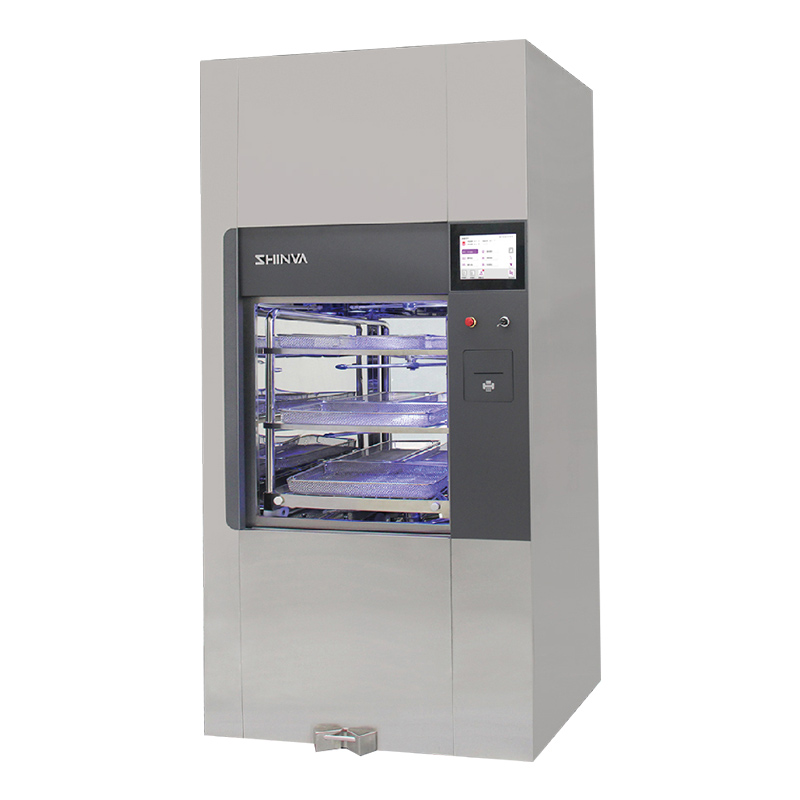
SHINVA Rapid-A-520 Washer-Disinfector for automated medical instrument cleaning and disinfection.
How Washer-Disinfectors Work
A washer-disinfector typically combines several controlled processing stages within an automated cycle.
Depending on the equipment, load, and selected program, these stages may include pre-rinsing, washing with detergent, intermediate rinsing, thermal disinfection, final rinsing, and drying.
The objective is not simply to expose instruments to hot water.
The system must coordinate several variables:
Mechanical action + Water quality + Chemistry + Temperature + Time + Load configuration
If one of these factors is unsuitable, overall process performance can be affected.
Core Technology and Operating Principle
Mechanical cleaning is generally achieved through controlled circulation and spraying of water and cleaning chemistry around the load.
The wash rack and spray system are particularly important because cleaning effectiveness depends on whether surfaces are properly exposed to the cleaning action.
Thermal disinfection then uses controlled moist heat to achieve the required disinfection process for compatible loads.
ISO 15883 uses the A₀ concept as a measure of microbiological lethality delivered by moist-heat disinfection, expressed as an equivalent exposure at 80°C under defined assumptions.
However, buyers should not treat a higher A₀ value as automatically meaning a better washer-disinfector.
The required process depends on the device category, intended application, applicable standards, manufacturer instructions, and facility procedures.
The useful procurement question is:
Can the washer-disinfector consistently achieve the required process for the intended load?
Critical Components and System Boundaries
A washer-disinfector should be evaluated as a complete system rather than only as a stainless-steel chamber.
Important system elements may include the chamber, circulation pumps, spray arms, loading racks, dosing system, heating system, sensors, water management, filtration, control system, drying system, and data-recording functions.
The loading equipment deserves particular attention.
Poor instrument placement can prevent water and detergent from reaching required surfaces.
SHINVA's Rapid-A-520, for example, uses modular wash-cart configurations for different load types, including surgical instruments, anesthesia accessories, minimally invasive instruments, bowls, and ophthalmic instruments. Its product documentation specifically notes that professional placement and correct loading are important for cleaning and disinfection performance.
This is why technical evaluation should include the rack and accessory configuration, not just the main machine.
Critical Performance Parameters
A specification sheet can contain dozens of parameters.
Only some of them directly help buyers determine whether a system fits their CSSD.
The most useful parameters are those that affect real processing performance and workflow.
| Technical Factor | Why It Matters |
|---|---|
| Practical load capacity | Determines actual CSSD throughput |
| Rack configuration | Affects instrument exposure and compatibility |
| Washing process | Influences soil removal |
| Thermal disinfection | Supports the required disinfection process |
| Rinse quality | Helps control residual chemistry |
| Drying performance | Affects downstream inspection and packaging |
| Cycle monitoring | Provides visibility into process conditions |
| Utility demand | Affects installation and operating cost |
These parameters should be evaluated together.
A washer with a large chamber but unsuitable racks may provide less practical capacity than a smaller system configured around the hospital's normal instrument sets.
Load Type and Capacity
Capacity should be measured in meaningful CSSD units.
Instead of comparing only chamber liters, buyers should determine how many of their standard trays or instrument sets can be processed during one cycle.
Loading requirements can vary significantly between surgical trays, anesthesia accessories, rigid endoscopic instruments, ophthalmic instruments, bowls, and other reusable items.
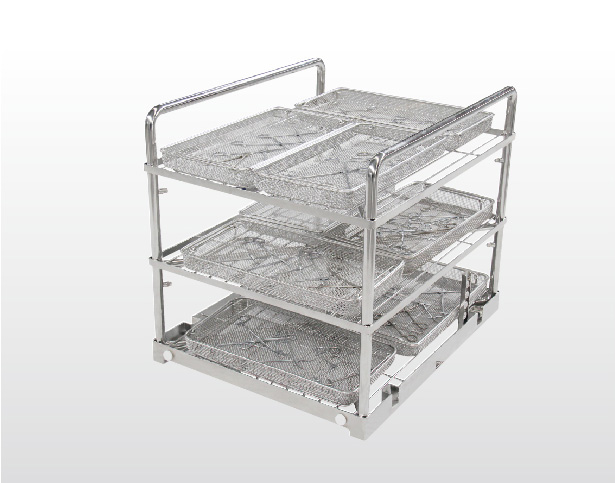
Example of an instrument wash cart used to organize loads during automated washing and disinfection.
The SHINVA Rapid-A-520 product range illustrates this point through multiple wash-cart options rather than relying on a single universal loading configuration.
A useful technical comparison therefore asks:
| Generic Specification | More Useful Evaluation |
|---|---|
| Chamber size | Standard trays processed per cycle |
| Maximum load | Actual hospital load configuration |
| Number of rack levels | Compatibility with intended instruments |
| Cycle duration | Throughput during peak operating periods |
| Loading accessories | Standard vs optional requirements |
This provides a much more realistic view of equipment performance.
Cycle or Process Performance
Cycle time is often used as a sales comparison point.
It should be interpreted carefully.
A shorter cycle is only valuable when it still provides the required cleaning, rinsing, disinfection, and drying performance for the intended load.
Hospitals should therefore understand which phases are included in the quoted cycle and which parameters are monitored.
For example, rinse-water quality may influence whether cleaning chemistry has been adequately removed before subsequent processing.
SHINVA's Rapid-A-520 includes an online conductivity monitoring function designed to monitor rinse-water conditions and add an additional rinse when specified conditions are not met. It also describes automatic adjustment of water fill according to loading capacity.
These are useful examples of why buyers should look beyond headline cycle time and examine how the process is controlled.
Design, Materials, and Compatibility
Washer-disinfector performance depends on the relationship between the equipment, cleaning chemistry, instruments, and adjacent CSSD processes.
Compatibility should therefore be evaluated at several levels.
Material Compatibility
Cleaning chemicals, temperatures, mechanical action, and exposure conditions should be suitable for the reusable medical devices being processed.
CDC guidance specifically recommends ensuring that detergents or enzymatic cleaners are compatible with the metals and other materials used in medical instruments. It also notes that rinsing should adequately remove residues that could interfere with later disinfection or sterilization processes.
This means procurement teams should not approve a detergent, cycle, or washer configuration independently of the instrument inventory.
Hospitals should review:
Device manufacturer instructions → Cleaning chemistry → Washer program → Loading system
as one connected compatibility chain.
This is especially important for specialized instruments with narrow lumens, delicate surfaces, joints, or complex geometry.
Compatibility With Adjacent Equipment and Processes
A washer-disinfector operates inside a larger CSSD workflow.
Its output becomes the input for inspection, assembly, packaging, and sterilization.
The system should therefore be evaluated in relation to:
Receiving → Pre-Cleaning → Washing & Disinfection → Inspection → Packaging → Sterilization → Storage
For pass-through installations, the relationship between contaminated and clean-side workflows becomes particularly important.
Loading carts, transport trolleys, transfer systems, and room layout can influence both productivity and operator movement.
For complete sterile processing projects, buyers can review the broader to consider washers, sterilizers, ultrasonic cleaners, drying equipment, water systems, and other supporting equipment as part of one workflow.
Quality Control, Safety, and Validation
Technical specifications describe what a machine is designed to do.
Validation and routine monitoring provide evidence that the process performs as required in its installed environment.
This distinction is important.
A product catalogue cannot replace project-specific verification.
ISO 15883-1:2024 includes requirements related to performance, testing, validation, routine control, monitoring, and requalification of washer-disinfectors.
Verification and Acceptance Points
Before equipment acceptance, the hospital and supplier should agree on what needs to be verified.
The exact requirements depend on the equipment, application, applicable standards, market, and facility procedures.
A practical review can include:
| Verification Area | Buyer Focus |
|---|---|
| Installed configuration | Does it match the purchase specification? |
| Utilities | Are water, power, drainage, and heating conditions correct? |
| Loading system | Are required racks and accessories supplied? |
| Programs | Are agreed cycles correctly configured? |
| Monitoring | Are required process parameters recorded? |
| Alarms | Are abnormal conditions identified appropriately? |
| Documentation | Are operating and maintenance documents available? |
| Training | Have relevant personnel completed handover training? |
For applicable medical-device washer-disinfectors, validation requirements should be aligned with relevant standards, manufacturer instructions, and local requirements.
Buyers should avoid creating arbitrary acceptance criteria after the machine has arrived.
Operational Risks and Control Measures
Several factors can degrade washer-disinfector performance even when the equipment itself is functioning.
Examples include poor loading, blocked spray paths, incorrect detergent dosing, unsuitable water conditions, insufficient maintenance, or using the wrong cycle for a load.
This is why quality control needs to extend into routine operation.
A useful control strategy connects:
Correct load → Correct rack → Correct cycle → Correct chemistry → Monitored process → Documented result
Operators should also recognize that automated cleaning does not eliminate the need for proper point-of-use handling and instrument preparation.
CDC guidance notes that cleaning should occur as soon as practical because dried soil can become more difficult to remove.
Automation improves consistency, but it cannot compensate for every upstream process failure.
Maintenance Factors That Affect Performance
Maintenance is not only a reliability issue.
It can also influence process performance.
A washer-disinfector may continue to run even when components such as spray arms, filters, dosing systems, sensors, or seals are no longer operating optimally.
This creates a strong argument for preventive maintenance.
Preventive Maintenance and Routine Checks
Routine checks should follow the specific manufacturer's instructions.
Depending on equipment design, important areas may include spray arms, filters, dosing systems, door seals, racks, sensors, water systems, and drying components.
| Maintenance Area | Potential Performance Impact |
|---|---|
| Spray arms | Reduced coverage or mechanical cleaning |
| Filters | Restricted water circulation |
| Dosing system | Incorrect detergent concentration |
| Sensors | Inaccurate process monitoring |
| Door seals | Leakage or operating problems |
| Loading racks | Poor spray access or connection |
| Water system | Rinse or cleaning performance issues |
Maintenance records also provide useful information for lifecycle management.
Repeated faults may reveal a site condition, loading practice, component issue, or maintenance problem that requires deeper investigation.
Common Failure Modes and Troubleshooting Questions
When cleaning performance deteriorates, replacing parts immediately is not always the best first response.
A structured troubleshooting process can ask:
Has the load changed?
Is the correct rack being used?
Are spray paths blocked?
Has detergent chemistry or dosing changed?
Has water quality changed?
Are cycle parameters operating as expected?
Has preventive maintenance been completed?
This approach separates equipment failure from process problems.
For procurement teams, supplier capability matters here.
A strong supplier should be able to support not only equipment repair but also technical troubleshooting across the complete washing process.
Turning Technical Specifications Into Purchase Criteria
The best washer-disinfector is not necessarily the machine with the highest temperature, largest chamber, shortest cycle, or most software functions.
Technical buyers should instead translate specifications into practical project questions.
| Specification | Purchase Criterion |
|---|---|
| Chamber and racks | Can our actual instrument loads be processed correctly? |
| Washing system | Can the process reach required instrument surfaces? |
| Thermal disinfection | Does the process meet the required application? |
| Monitoring | Can critical operating conditions be reviewed? |
| Water management | Does it fit site conditions and rinse requirements? |
| Drying | Does it support downstream workflow? |
| Validation support | Can required verification activities be completed? |
| Maintenance | Can performance be supported over the lifecycle? |
This framework creates a more objective comparison between different washer-disinfector proposals.
It also prevents procurement decisions from being dominated by individual headline specifications.
Buyer Insight: Performance Is a System Property
A washer-disinfector does not produce good results because of one component.
Performance comes from the interaction between:
Machine design + Load configuration + Chemistry + Water + Cycle parameters + Operator practice + Validation + Maintenance
That is why technical research should focus on the complete system.
A machine can meet strong design specifications and still perform poorly when loaded incorrectly.
Likewise, a well-designed CSSD workflow can be limited by equipment that lacks appropriate racks, monitoring, serviceability, or technical support.
The best procurement decision recognizes these dependencies before the equipment is installed.
Conclusion: Turn Technical Specs Into Purchase Criteria
Understanding washer disinfector specifications requires more than reading a product datasheet.
CSSD and infection control teams should evaluate how the equipment performs as part of a controlled cleaning and disinfection system.
The most important technical areas include load compatibility, practical capacity, washing mechanics, thermal disinfection, rinse quality, drying, monitoring, validation, maintenance, and integration with the wider CSSD workflow.
ISO 15883 provides an important technical framework for washer-disinfector performance, validation, routine monitoring, and testing, while CDC guidance reinforces the importance of thorough cleaning, compatible chemistry, appropriate mechanical cleaning, and correct equipment use.
Healthcare buyers can review the when evaluating available system configurations.
For a CSSD project, technical specification review, or washer-disinfector RFQ, with your load types, expected throughput, installation conditions, and validation requirements.
Frequently Asked Questions
What is a washer disinfector used for?
A washer disinfector provides automated cleaning and disinfection of compatible reusable medical devices before subsequent inspection, packaging, sterilization, or other processing stages.
How does a washer disinfector work?
The equipment typically combines controlled water circulation, detergent chemistry, mechanical washing, rinsing, thermal or other applicable disinfection processes, and sometimes drying within an automated cycle.
What washer disinfector specifications matter most?
Important specifications include practical load capacity, wash-rack configuration, process performance, disinfection control, rinse quality, drying, monitoring, utilities, and maintenance requirements.
What validation documents should buyers request?
Documentation depends on the equipment, project, and regulatory environment. Buyers should confirm technical specifications, installation requirements, operating documentation, applicable testing or validation information, commissioning records, and maintenance requirements.
Why is ISO 15883 important for washer-disinfectors?
The ISO 15883 series establishes requirements and testing frameworks for different washer-disinfector applications. ISO 15883-1:2024 covers general requirements, performance, validation, monitoring, and requalification, while other parts address specific applications.