Medical Equipment Planning: A Complete Workflow and Service Guide for Hospitals
How should hospitals plan medical equipment before installation? A strong project begins long before a purchase order. It starts with clinical needs and ends with maintenance, training, and lifecycle management.
WHO places planning, assessment, acquisition, management, and use within the broader management of medical devices. For hospital buyers, distributors, and project contractors, that framing carries one practical implication:
Medical equipment should be planned as part of a working system, not as a collection of individual machines.
SHINVA's current medical business covers infection control, operating room solutions, radiotherapy, laboratory systems, surgical instruments, and other healthcare equipment. Buyers can start with the before defining a department-level equipment plan.
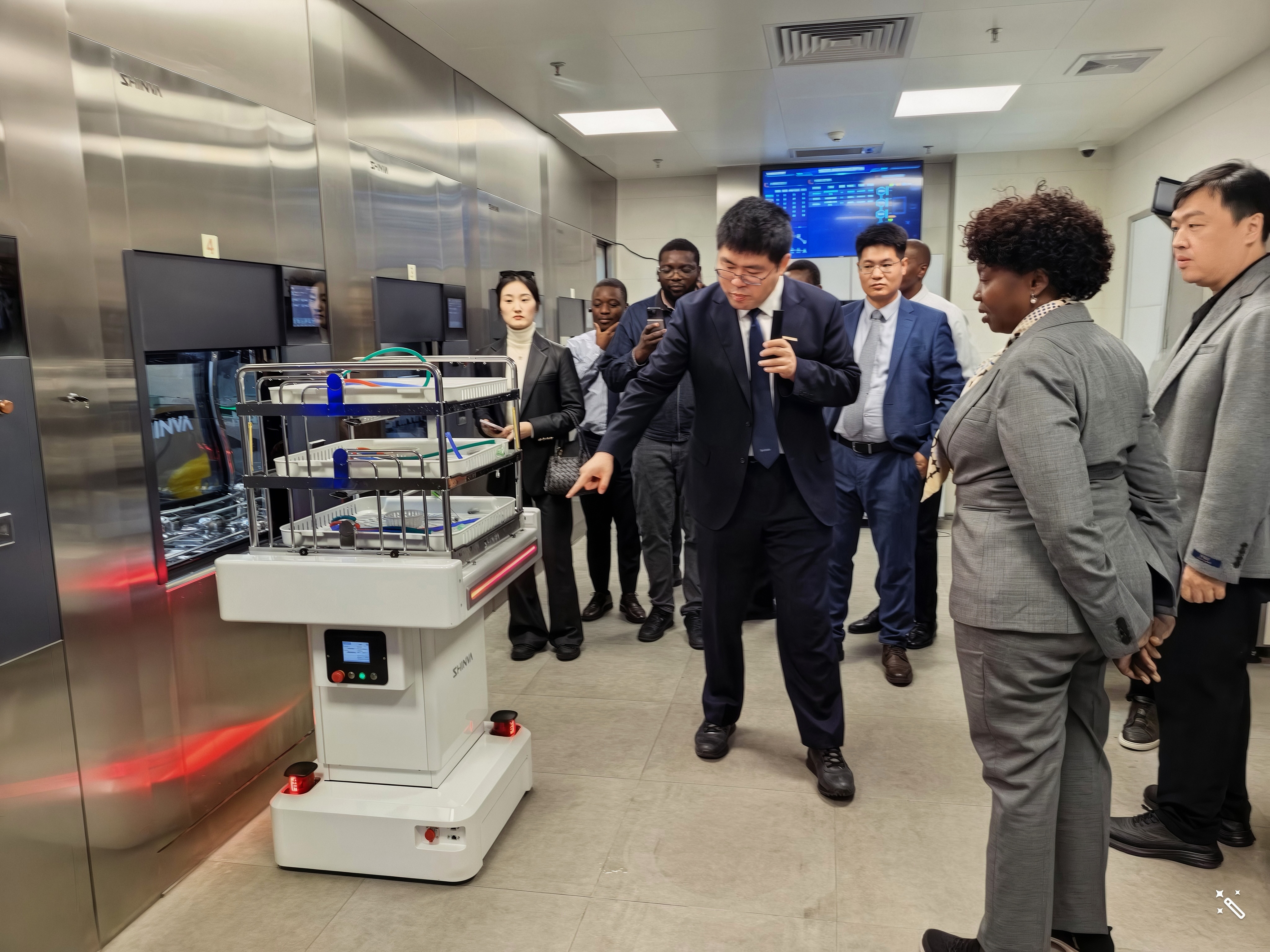 SHINVA equipment shown in an operating hospital CSSD workflow during a 2026 international delegation visit.
This guide walks through a five-stage planning model—from needs assessment through workflow design, facility fit, installation, training, and long-term service—that hospitals, distributors, and project teams can use to plan medical equipment as one connected system rather than a shopping list.
A Five-Stage Medical Equipment Planning Model
Medical equipment planning becomes far easier when a project follows a clear sequence. A practical model breaks the work into five stages:
Needs assessment
Workflow and capacity planning
Site and equipment configuration
Installation and training
Maintenance and lifecycle management
Each stage affects the next—a poor decision early in the project tends to resurface as an installation or operating problem much later, when it's far more expensive to fix.
Stage 1: Start With a Medical Equipment Needs Assessment
Equipment planning should begin with the healthcare service itself, not with a model number.
Define the Clinical or Operational Goal
Start by asking what the department actually needs to achieve—for example: increasing sterile processing capacity, building a new operating room, upgrading an endoscopy department, expanding laboratory capacity, establishing a radiotherapy center, replacing aging equipment, or reducing workflow bottlenecks.
This goal becomes the basis for equipment selection. The equipment list should follow the service model—the service model should never follow the equipment catalogue.
Identify Everyone Who Uses or Supports the Equipment
A project typically involves doctors, nurses, technicians, biomedical engineers, infection control staff, facility engineers, procurement managers, IT teams, and maintenance staff, and each group sees different risks. Clinical users tend to focus on usability, engineering teams focus on utilities, procurement teams focus on documentation and delivery, and maintenance teams need service access and spare parts above all.
Bring all of these groups into the project before specifications become fixed, not after.
Stage 2: Design the Workflow Before Selecting Equipment
Workflow design is one of the most overlooked parts of medical equipment planning. The question isn't only "what equipment do we need?"—a better question is "how will people, materials, equipment, and information actually move through the department?"
Map the Current Process
Start by documenting the actual workflow. A simple map can show:
Input → Processing → Transfer → Output → Storage
For a CSSD, that becomes:
Collection → Cleaning → Inspection → Packaging → Sterilization → Storage → Distribution
SHINVA describes a 2026 CSSD project that integrates cleaning, disinfection, sterilization, traceability, storage, and sterile distribution into one connected workflow—a clear illustration of why buyers should evaluate the whole process rather than one machine at a time. A single high-capacity unit cannot fix a bottleneck sitting in a different stage of the workflow.
Look for Workflow Bottlenecks
Common problems include insufficient cleaning capacity, long transfer distances, poor separation of clean and contaminated areas, limited storage, equipment queues, repeated manual handling, and insufficient backup capacity. The fix may require layout changes, different equipment sizing, or both.
For sterile processing projects, buyers can review as one connected system rather than a list of individual machines.
Plan Around Real Workload, Not Just Averages
Don't calculate capacity from average demand alone. Factor in daily and peak workload, operating hours, cycle times, turnaround targets, emergency demand, future growth, and expected equipment downtime. A department running near maximum capacity every day has almost no room for disruption—some projects need built-in redundancy, others need reserved space for future expansion.
A Practical Medical Equipment Planning Matrix
Before selecting products, project teams can work through a simple planning matrix:
| Planning Area | Questions to Answer |
|---|---|
| Clinical Need | What service will the equipment support? |
| Workload | What is average and peak demand? |
| Users | Who operates and maintains the system? |
| Workflow | What happens before and after each process? |
| Space | How much room is available? |
| Utilities | What power, water, drainage, air, or network is required? |
| Integration | What other systems must connect? |
| Training | Which users need training? |
| Maintenance | Who will service the equipment? |
| Expansion | Will future capacity increase? |
This matrix keeps product selection tied to project reality instead of drifting toward whatever a supplier happens to be promoting.
Stage 3: Match Medical Equipment to the Facility
A product can meet every technical specification on paper and still fail to fit the site. Facility planning has to happen before equipment is finalized, not after.
Check Space and Installation Access
Confirm room dimensions, door dimensions, corridor width, elevator capacity, equipment footprint, service clearance, and maintenance access. Don't evaluate only the final operating location—the equipment also needs a physical route into the building.
Confirm Utility Requirements Early
Depending on the equipment, the site may need electrical power, treated water, drainage, steam, compressed air, ventilation, exhaust, network connections, or environmental controls. Request these requirements during technical evaluation, not once installation has already begun.
Consider the Entire Department Layout
Some equipment shapes room design directly, and operating rooms are the clearest example. SHINVA's integrated operating room offering covers clean-room design and construction, medical equipment, and information control software together. Buyers planning new surgical spaces can review the category while the room layout is still being developed—the position of tables, lights, pendants, utilities, and staff routes all need to work as one system.
Stage 4: Plan Installation as a Project, Not a Delivery
Delivery isn't the end of procurement—it's the beginning of implementation. A clear installation plan defines responsibilities well before equipment arrives.
Build a Site-Readiness Checklist
Before shipment, confirm that room construction is complete, utilities match specification, access routes are open, installation teams are scheduled, required tools are available, local contractors understand their scope, and acceptance criteria are agreed in writing. A single missing electrical connection—or a doorway that's too narrow—can delay an entire project. These are planning problems, not equipment problems.
Define Who Does What
A responsibility matrix prevents confusion once multiple parties are on-site:
| Task | Buyer | Supplier | Local Contractor |
|---|---|---|---|
| Site preparation | ✓ | Review | ✓ |
| Equipment delivery | Coordinate | ✓ | Support |
| Utility connection | Coordinate | Review | ✓ |
| Installation | Support | ✓ | Support |
| Commissioning | Witness | ✓ | Support |
| User training | Attend | ✓ | — |
| Acceptance | ✓ | Support | Support |
The exact division depends on the contract—document it before the equipment arrives, not while it's sitting in the loading dock.
Stage 5: Build Training Into the Medical Equipment Workflow
Training shouldn't happen as a short demonstration tacked onto the end of installation. Different teams need different knowledge, delivered at different depths.
Operator Training
Operators need to understand normal startup, workflow, loading, controls, alarms, daily checks, cleaning, and shutdown—training should map directly onto real daily tasks, not a generic product overview.
Biomedical and Maintenance Training
Technical teams need considerably deeper information: preventive maintenance, service intervals, troubleshooting, parts replacement, diagnostic functions, calibration requirements, and documentation. WHO notes that trained biomedical engineering professionals play a direct role in evaluating, maintaining, managing, and supporting the safe use of medical devices.
Use Training to Pressure-Test the Workflow
Training sessions often expose problems before routine operation begins—users may discover that equipment positioning is inconvenient, loading routes are inefficient, accessories are missing, or responsibilities are still unclear. Resolve these issues before full handover, while the installation team is still on-site.
Medical Equipment Service Should Begin Before a Failure
After-sales service shouldn't start the moment equipment breaks down. A better model begins with preventive planning, well before anything goes wrong.
WHO describes maintenance strategy as spanning inspection, preventive maintenance, and corrective maintenance—with preventive maintenance specifically aimed at extending equipment life and reducing failure rates.
Build a Preventive Maintenance Plan
Ask the supplier for inspection intervals, maintenance frequency, replacement parts, consumables, service procedures, required tools, and recommended spare parts, then assign clear ownership. A maintenance plan without a named owner rarely gets followed.
Plan Spare Parts Before They're Needed
Identify critical components and evaluate their lead time, local availability, international shipping, shelf life, and recommended stock levels. A single small, unavailable component can create surprisingly significant downtime.
Clarify the Full Service Model
Ask directly: Is service available locally? Does the manufacturer support remote diagnostics? Who performs advanced repairs? What training can local engineers receive? How are spare parts ordered? What happens after the warranty expires?
SHINVA states that its customized endoscope solutions can include installation, operator training, and after-sales support—but for any specific project, buyers should still confirm the exact service scope in writing, inside the contract.
Workflow Integration Matters More Than Individual Equipment
Some hospital projects fail not because any single product underperforms, but because equipment was selected department by department—each unit works fine on its own, but the complete workflow doesn't.
Connect Equipment With Information
Modern workflows increasingly involve traceability, scheduling, data recording, equipment status, resource allocation, and maintenance records. SHINVA's 2026 Intelligent Endoscopy Center project describes exactly this kind of integration between medical equipment, information systems, and department management.
That doesn't mean every facility needs the same level of digitalization—it means information flow deserves consideration during equipment planning, not as an afterthought once machines are already installed.
Plan Interfaces Early
Ask whether equipment needs HIS integration, whether traceability is required, whether several machines will share data, who owns system integration, and what network support is required. These questions become far more expensive to answer after installation than before it.
Different Medical Departments Need Different Planning Priorities
One planning framework can support many kinds of projects, but the priorities shift by department.
CSSD and infection control planning should focus on dirty-to-clean flow, capacity balance, sterilization workflow, storage, traceability, and water/utilities.
Operating room planning should focus on ergonomics, equipment positioning, utilities, lighting, pendants, clean-environment control, and information integration.
Laboratory planning should focus on sample flow, biosafety, ventilation, washing, sterilization, and equipment zoning. Buyers planning research or animal facilities can review during layout development.
Radiotherapy planning should focus on site design, treatment workflow, simulation, planning, commissioning, QA, and long-term service. Large oncology projects should evaluate at the system level rather than comparing individual devices in isolation.
Medical Equipment Planning Risks to Check Before Purchase
Before approving a final configuration, check the project for these recurring warning signs:
Equipment selected before workflow mapping — the project risks a capacity imbalance between stages.
Utilities still unconfirmed — installation risk stays high until this is resolved.
Nobody owns integration — interfaces are likely to fail during commissioning.
Training treated as optional — users tend to struggle after handover.
Maintenance has no budget — downtime risk climbs accordingly.
Spare parts discussed only after a failure — repair times get longer, not shorter.
Future capacity ignored — the facility can outgrow the equipment faster than expected.
A Better Medical Equipment Project Workflow
A practical project can follow this sequence:
1. Define the healthcare service 2. Map patient, material, staff, and information flow 3. Calculate capacity 4. Define room and utility requirements 5. Select equipment configuration 6. Confirm interfaces 7. Prepare the site 8. Install and commission 9. Train users and technical teams 10. Establish maintenance and service
This sequence changes the operative question from "which machine should we buy?" to "which system will support this workflow for the long term?"—a far better starting point for any complex healthcare project.
Conclusion: Design the Workflow Around People and Process
Medical equipment planning should connect technology with people, rooms, utilities, processes, service, and future demand. The strongest projects begin with workflow—they don't begin with a catalogue.
Before choosing equipment: define the clinical need, map the process, calculate capacity, confirm infrastructure, identify system interfaces, plan training, and establish maintenance responsibilities. This approach gives hospitals and distributors a clearer basis for supplier evaluation, and it substantially reduces problems during installation and handover.
For multi-department hospital projects, buyers can explore before defining a detailed equipment list. If you already have a floor plan, department concept, or equipment requirement, and use the planning framework above to structure the discussion.
Frequently Asked Questions
When should medical equipment planning begin?
Planning should begin at the earliest project stage—the team should define workflows, capacity, space, and utilities well before final equipment selection, not after.
What should a medical equipment plan include?
It should cover equipment scope, capacity, layout, utilities, interfaces, installation, training, maintenance, and future expansion as one connected plan.
Why is workflow important in medical equipment planning?
Workflow shows how people, materials, equipment, and information actually move through a department, which helps identify bottlenecks before equipment is installed rather than after.
Who should participate in medical equipment planning?
Typically clinical users, biomedical engineers, facility engineers, infection control staff, procurement teams, IT staff, and project managers—each brings a different, necessary perspective.
How should hospitals plan medical equipment maintenance?