Washer-Disinfectors in CSSD and Hospital Workflows
A washer disinfector is not an isolated cleaning machine. In a Central Sterile Supply Department (CSSD), it is part of a connected workflow that moves reusable medical devices from contaminated receiving through cleaning, disinfection, inspection, packaging, sterilization, storage, and eventual release for clinical use.
For hospitals, this means equipment performance should never be evaluated only by chamber capacity or cycle time.
The more practical question is:
How does the washer-disinfector fit into the complete sterile processing workflow?
The CDC emphasizes that reusable medical devices should be thoroughly cleaned before subsequent high-level disinfection or sterilization because remaining organic and inorganic material can interfere with later processing. Mechanical cleaning methods can include washer-disinfectors, and automatic equipment should be used according to the manufacturer's recommendations.
SHINVA provides washer-disinfectors as part of its broader infection control portfolio. Hospitals planning a CSSD project can review the together with other .
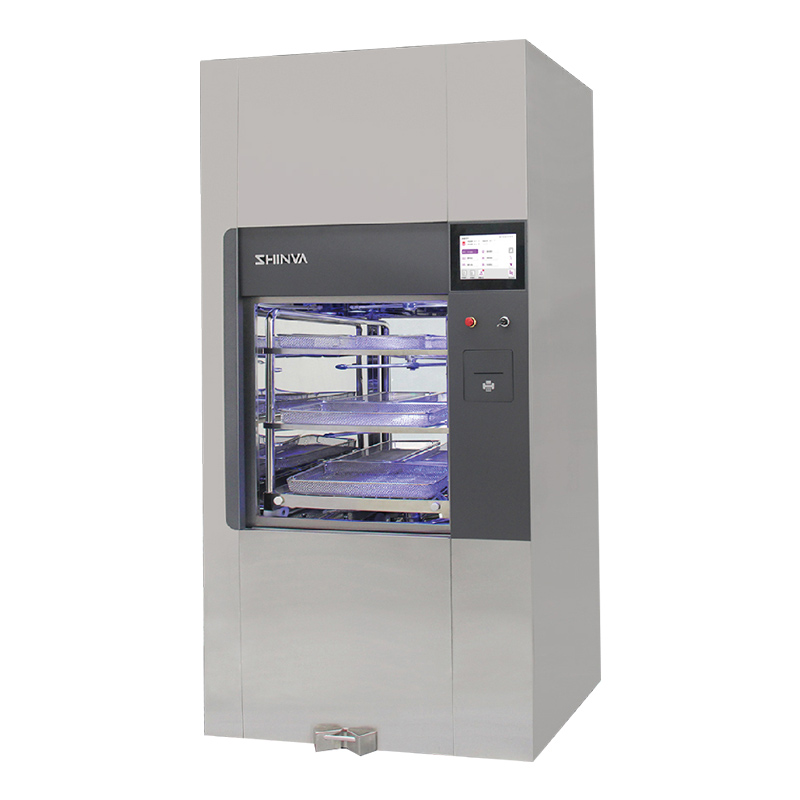
Washer-disinfector equipment should be planned as part of the complete CSSD workflow rather than as a standalone machine.
This guide examines washer disinfector applications, installation planning, staff workflow, upstream and downstream integration, and the operational issues hospitals should consider when building or upgrading a CSSD.
Map Washer-Disinfectors to the Facility Workflow
The first step in planning washer-disinfectors is understanding where they belong in the movement of contaminated instruments.
A simplified CSSD workflow may look like:
Point of Use
↓
Contaminated Receiving
↓
Sorting and Pre-Cleaning
↓
Automated Washing & Disinfection
↓
Inspection and Assembly
↓
Packaging
↓
Sterilization
↓
Sterile Storage
↓
Distribution
Every stage affects the next one.
A bottleneck in washing can delay packaging. Insufficient clean-side capacity can cause processed loads to accumulate. Poor instrument preparation can reduce the effectiveness of automated washing.
This is why washer-disinfector planning should begin with process mapping rather than equipment selection.
Pre-Cleaning Before Automated Washing
A washer-disinfector should not be expected to compensate for poor instrument handling before the load reaches the machine.
The CDC recommends cleaning medical devices as soon as practical after use because dried soil becomes more difficult to remove and can interfere with later disinfection or sterilization.
Hospitals should therefore define how instruments move from the point of use to the decontamination area.
Depending on the device and facility procedures, upstream activities may include initial removal of gross contamination, sorting, disassembly, preparation of hinged instruments, or other device-specific steps.
The exact process should follow the reusable device manufacturer's instructions.
The important workflow principle is that instruments should arrive at the washer in a condition suitable for the validated cleaning process.
Washing and Disinfection
Inside the washer-disinfector, the process may combine several controlled stages such as washing, rinsing, thermal disinfection, and drying.
ISO 15883-1:2024 establishes general performance requirements for washer-disinfectors used for cleaning and disinfection of reusable medical devices. It also covers validation, routine control, monitoring, and requalification.
For CSSD managers, however, technical compliance is only part of the operational question.
The equipment must also handle the hospital's actual loads.
Surgical instruments, anesthesia accessories, bowls, ophthalmic instruments, and other reusable items can require different loading configurations.
SHINVA's Rapid-A-520 illustrates this workflow approach through modular wash-cart options designed for different instrument categories.
Plan the Site Before Installation
A washer-disinfector project can fail operationally even when the equipment itself is technically suitable.
Poor layout, inadequate utilities, limited loading space, or insufficient clean-side handling capacity can reduce the efficiency of an otherwise capable system.
Site planning should therefore happen before the equipment configuration is finalized.
Space, Utilities, Interfaces, and Environment
The hospital engineering team should review equipment dimensions together with the space needed for loading, unloading, service access, transport carts, and maintenance.
Utility requirements may include:
| Site Factor | Planning Consideration |
|---|---|
| Water | Supply conditions and required water quality |
| Drainage | Capacity and connection location |
| Electricity | Required electrical supply |
| Steam | Availability where applicable |
| Ventilation | Room and equipment requirements |
| Service clearance | Access for maintenance |
| Transport route | Delivery and equipment replacement access |
SHINVA's Rapid-A-520, for example, describes integrated steam and electric heating options designed for different installation conditions.
This demonstrates why buyers should not assume that two washer-disinfectors with similar cleaning functions will have identical infrastructure requirements.
A site survey can identify these differences before they become construction changes.
People, Material, and Information Flow
CSSD design should consider three flows at the same time:
People
How do operators move between receiving, washing, inspection, and packaging areas?
Materials
How do contaminated instruments enter the department, and how do clean instruments continue downstream?
Information
How are loads identified, recorded, reviewed, and released?
These flows should support one another.
If operators repeatedly cross between contaminated and clean activities, the layout may require reconsideration.
If wash carts have no clear staging location, loading efficiency can decline during peak periods.
If process information cannot be connected with instrument or load records, traceability may become fragmented.
The washer-disinfector should therefore be positioned within the operational system, not simply wherever there is enough floor space.
Typical Washer-Disinfector Operating Sequence
A practical operating sequence begins before the machine door closes and continues after the load has been removed.
A typical example is:
| Stage | Operational Focus |
|---|---|
| Load preparation | Correct instruments and rack selection |
| Loading | Proper positioning and spray access |
| Program selection | Appropriate cycle for the intended load |
| Automated processing | Washing, rinsing, disinfection and drying as configured |
| Unloading | Controlled transfer to the clean side |
| Inspection | Confirm cleanliness and instrument condition |
| Downstream processing | Assembly, packaging or other required steps |
Correct loading deserves particular attention.
Even an advanced washer cannot provide effective mechanical action if instruments are arranged in a way that prevents cleaning solution from reaching required surfaces.
This is one reason the rack configuration should be considered part of the washer-disinfector system.
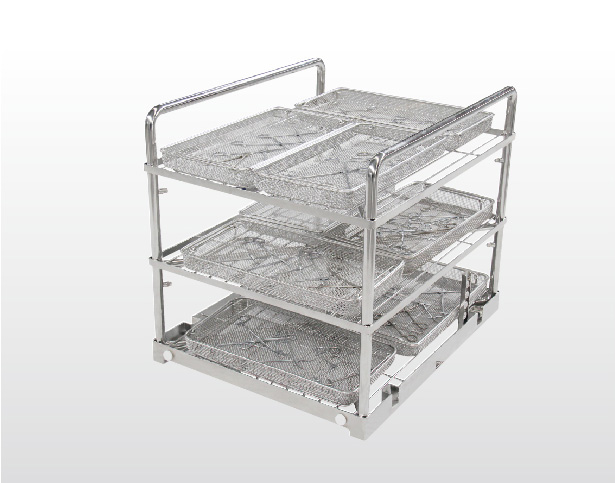
Loading racks and carts influence practical throughput, instrument exposure, and integration with CSSD material flow.
Sterilization or Drying
The washer-disinfector is usually not the final processing stage for reusable critical surgical instruments.
After cleaning and disinfection, instruments may move into inspection, assembly, packaging, and sterilization according to their intended use and manufacturer instructions.
This creates an important capacity relationship.
If a CSSD can wash instruments faster than staff can inspect and package them, the downstream area becomes the bottleneck.
Likewise, adding washer-disinfector capacity without reviewing sterilizer throughput may simply move the queue from one area to another.
For complete planning, hospitals can evaluate washer-disinfectors alongside rather than purchasing each system independently.
Storage and Release
After the required downstream processing is complete, items may move into sterile storage and distribution according to facility procedures.
The washer-disinfector influences this stage indirectly.
Reliable and predictable cleaning cycles help create a more stable flow into inspection, packaging, sterilization, and storage.
Inconsistent throughput can make instrument availability harder to manage.
This is why CSSD equipment capacity should be evaluated as a chain rather than as individual machines.
Integrate Upstream and Downstream Systems
Modern CSSDs increasingly combine mechanical equipment with transport systems, water treatment, digital records, and other workflow-supporting technologies.
Integration does not necessarily mean creating a completely automated department.
It means ensuring that one process hands off efficiently to the next.
Equipment Interfaces and Data Handoffs
Physical integration may involve transport trolleys, loading racks, transfer windows, conveyors, or pass-through equipment.
SHINVA describes loading and transport trolley options for the Rapid-A-520, including docking with washer-disinfectors and transfer windows. Automatic loading and unloading systems are also listed as optional configurations.
For a high-throughput CSSD, these details can affect staff workload and turnaround time.
Digital integration may also matter.
Depending on equipment configuration and hospital requirements, buyers may evaluate cycle records, alarms, operator identification, process data, or interfaces with broader tracking systems.
The procurement team should define these requirements before supplier selection.
A feature only creates value when the department has a practical use for the information it generates.
Bottlenecks, Redundancy, and Expansion Planning
One washer-disinfector may theoretically meet average daily demand.
That does not automatically mean one machine is sufficient.
Hospitals should also consider:
Peak workload — surgical activity is rarely distributed evenly throughout the day.
Downtime — preventive maintenance and unexpected failures temporarily reduce available capacity.
Future expansion — additional operating rooms or procedures may increase instrument volume.
Downstream capacity — washing should not consistently overload inspection, packaging, or sterilization areas.
A useful planning method is to map approximate capacity at every major stage.
| CSSD Stage | Capacity Question |
|---|---|
| Receiving | Can peak contaminated loads be handled? |
| Pre-cleaning | Is preparation keeping pace? |
| Washer-disinfector | Is practical cycle capacity sufficient? |
| Inspection | Can staff process washed loads? |
| Packaging | Is there enough workstation capacity? |
| Sterilization | Can sterilizers absorb downstream demand? |
| Storage | Is processed inventory managed efficiently? |
The objective is balanced throughput.
Buying the fastest machine in one stage does little if another stage remains overloaded.
Training, Risk Control, and Workflow Optimization
Technology does not eliminate the human element in sterile processing.
Staff still determine whether instruments are prepared correctly, placed in the appropriate rack, assigned to the correct program, inspected after processing, and moved to the correct downstream stage.
Training should therefore be planned alongside equipment installation.
Role-Based Training and SOP Alignment
Different employees need different training.
Operators may need detailed guidance on loading, cycle selection, alarms, cleaning routines, and daily checks.
Supervisors may need to understand process records, workload management, exception handling, and quality review.
Biomedical engineers or technical teams may require maintenance and troubleshooting knowledge.
Training should also align with the facility's standard operating procedures.
The goal is not merely learning how to operate the touchscreen.
Staff should understand why each step exists and how their actions affect the wider sterile processing workflow.
KPIs, Review Points, and Continuous Improvement
Once a washer-disinfector enters routine operation, CSSD managers can review whether the workflow is performing as expected.
Useful operational measures depend on facility needs but may include:
load turnaround;
equipment utilization;
delays between processing stages;
reprocessing events;
equipment downtime;
maintenance events.
The objective is not collecting as much data as possible.
It is identifying where workflow friction occurs.
For example, if washed instruments routinely wait for inspection, purchasing another washer may not solve the problem.
If machines remain idle while contaminated items wait for sorting, the upstream workflow may need attention.
If equipment downtime frequently disrupts the department, preventive maintenance or redundancy planning may require review.
This turns equipment data into operational improvement.
Common Workflow Problems Around Washer-Disinfectors
Poor Load Preparation
Automated processing cannot compensate for every upstream handling problem.
Staff need a clear process for preparing instruments before loading.
Incorrect Rack Selection
Different instrument groups may require different racks or modules. Using an unsuitable configuration can affect both capacity and cleaning access.
Unbalanced Department Capacity
Increasing washing capacity without reviewing inspection, packaging, and sterilization can simply relocate the bottleneck.
Insufficient Staging Space
A technically efficient washer can still create congestion when there is nowhere to stage dirty or processed carts.
Weak Maintenance Planning
Washer-disinfectors are operational assets. Planned maintenance should be built into department capacity and scheduling.
Buyer Insight: Design the Workflow Before Choosing the Machine
The most useful question in a washer-disinfector project is not:
Which machine has the best specifications?
It is:
What should happen before, inside, and after this machine?
Once the hospital understands the complete workflow, equipment selection becomes much clearer.
The department can define realistic load types, practical capacity, rack configurations, room layout, utilities, staffing, downstream throughput, redundancy, and future expansion.
Then the washer-disinfector can be evaluated against those requirements.
This approach also makes supplier proposals easier to compare because every company is being asked to solve the same operational problem.
Conclusion: Design the Workflow Around People and Process
The role of washer-disinfectors in CSSD extends far beyond automated washing.
They connect contaminated receiving and pre-cleaning with inspection, packaging, sterilization, storage, and instrument redistribution.
Successful implementation therefore depends on the interaction between:
equipment + people + layout + utilities + loading systems + downstream capacity + maintenance + information flow.
Hospitals planning a CSSD project should map these relationships before finalizing equipment selection.
This creates a stronger foundation for deciding how many washer-disinfectors are needed, which loading systems are appropriate, where equipment should be installed, and how future expansion can be accommodated.
Review the when evaluating washer-disinfector configurations for hospital sterile processing.
For broader CSSD planning, buyers can also explore or with the expected workload, instrument mix, hospital layout, and project requirements.
Frequently Asked Questions
What is a washer disinfector used for in CSSD?
A washer-disinfector provides controlled mechanical cleaning and disinfection of compatible reusable medical devices before downstream processing such as inspection, packaging, and sterilization.
Where should a washer disinfector be installed in the CSSD workflow?
It is generally positioned within the decontamination and cleaning stage. The exact layout depends on facility design, contaminated and clean-side separation, loading method, and equipment configuration.
How many washer-disinfectors does a hospital need?
The number depends on practical load capacity, cycle duration, peak instrument demand, operating hours, redundancy requirements, maintenance downtime, and the capacity of upstream and downstream CSSD processes.
What affects washer disinfector workflow efficiency?
Important factors include load preparation, rack selection, instrument arrangement, processing capacity, staging space, staff training, downstream capacity, equipment reliability, and department layout.
Should washer-disinfectors be planned together with sterilizers?
Yes. Washing and sterilization are connected stages in the sterile processing workflow. Capacity planning should consider inspection, packaging, sterilization, and storage rather than optimizing the washer-disinfector alone